
Announcing North Burial Ground Gateway Landmark Public Art: “The Lighthouse” by Paula Castillo
The Mayor of Providence, the Department of Art, Culture and Tourism, and the Art in City Life Commission are proud to announce that Paula Castillo and her piece, The Lighthouse have been selected for a new piece of Landmark Public Art, commissioned as a Gateway piece at North Burial Ground. Supported by Providence’s Percent for Art via the Art in City Life Ordinance, this large-scale, signature, permanent work of art will be a highly visible, celebratory investment that places a spotlight on the whole of the City. The site selected — North Burial Ground near North Main St will act as a beacon and landmark as anyone is coming into or leaving Providence from the North. An additional piece of Gateway Landmark Public Art coming to Neutaconkanut Park will be announced in the coming weeks.
After an international call released in October 2025, over 180 qualified artists submitted portfolios for review by a highly qualified group of art selection panelists with a wide range of creative, institutional, academic, and production-specific backgrounds. That body narrowed the field to eight semi-finalists, four at North Burial Ground and four at Neutaconkanut Hill Park.
Each of the semi-finalists was contracted for a design stipend and given six weeks to create a design proposal specific to the location the selection panel assigned.
The four semi-finalists at North Burial Ground were:
Paula Castillo
Joshua Enck
Norman Lee
Patricia Leighton
Paula Castillo’s piece, The Lighthouse was selected as the finalist by the art selection committee, which was then approved by both the Art in City Life Commission and the Board of Parks Commissioners. Joshua Enck’s piece, Esker and Patricia Leighton’s earthworks piece were the alternates.
ABOUT THE LIGHTHOUSE
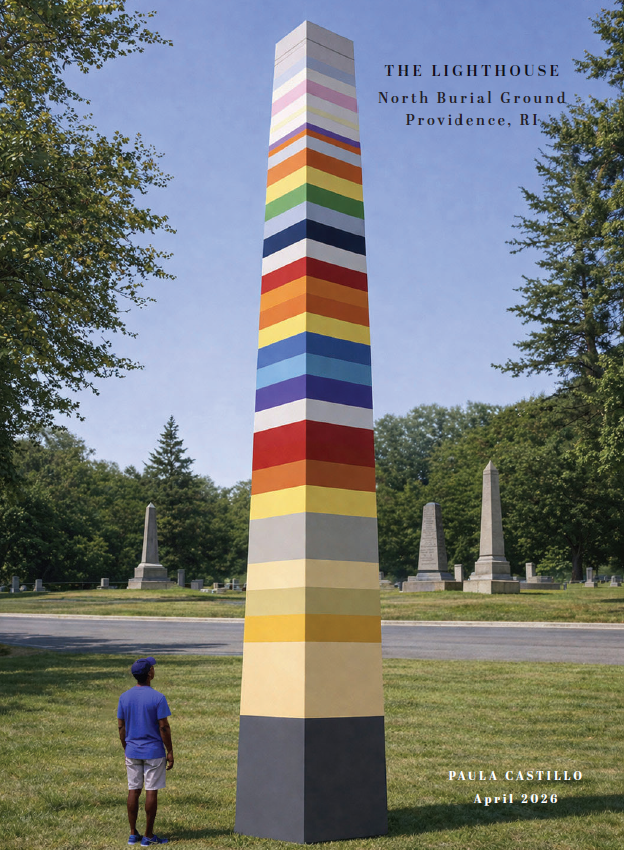
The City of Providence seeks a landmark that signals revitalization and establishes presence toward downtown within North Burial Ground, a site held in profound regard as a complex civic space shaped by layered histories. The originality of The Lighthouse lies in holding both ambitions at once, strengthening landmark presence while preserving the dignity and complexity of the cemetery.
North Burial Ground is a living civic record.
For more than 300 years, it has served Providence as a municipal commons. It remains a burial ground, walking park, and wildlife corridor. Within its 110 acres rest governors and laborers, abolitionists and enslavers, immigrants, teachers, the poor, the unnamed, the segregated, and the reintegrated. The city’s values appear here in stone, placement, and absence.
Some lives are marked prominently. Others remain unmarked or absorbed into shared ground. Over generations, the landscape has shifted with changing ideas about care, status, separation, and belonging. The cemetery does not tell one story but shows how a city changes over time.
Extending this condition, my proposal, The Lighthouse, records adjacency and accumulation vertically, gathering difference into shared ground.
Adopting the obelisk’s vertical clarity, the sculpture transcribes it into a contemporary shared language. North Burial Ground contains numerous obelisks, markers associated with permanence, authority, and individual prominence. In its nineteenth-century context, the obelisk functioned as a colonial monument derived from Egyptian precedent and absorbed into Western memorial hierarchy.
The obelisk typology is engaged consciously.
Unlike the traditional obelisk, which resolves in a pyramidal apex concentrating authority at a singular point, the form does not culminate in a pointed crown. It remains open, resisting hierarchical closure. Rather than marking an individual life, inscription is replaced with calibrated color, redistributing attention across a continuous vertical spectrum.
The spirit of welcome at North Burial Welcome begins with perception. Ground is active rather than ceremonial.
It is a working landscape that receives people in moments of grief, routine, reflection, and return. Visitors arrive for burial services, morning walks, genealogical searches, solitary pauses, and daily transit through a deliberately tended landscape that offers respite from surrounding urban life while functioning as a wildlife corridor.
The grounds are both sacred and ordinary, shaped by repetition and memory.
As shared by Director Annalisa Heppner, most families gather not on death anniversaries but on birthdays, decorating graves in celebration rather than solely in mourning. Love is revisited and made visible across generations. Remembrance here is lived and renewed.
Reinforcing this openness without prescribing behavior or interpretation, the work allows entry through perception rather than instruction. A child approaching the gate may first register color rather than typology.
Lower earth tones meet eye level.
Middle bands intensify.
Upper hues lift beyond reach.
The experience is intuitive before it is historical. Curiosity precedes explanation.
In this way, multiple levels of understanding, scholarly, familial, and incidental, coexist without hierarchy.
ABOUT THE ARTIST
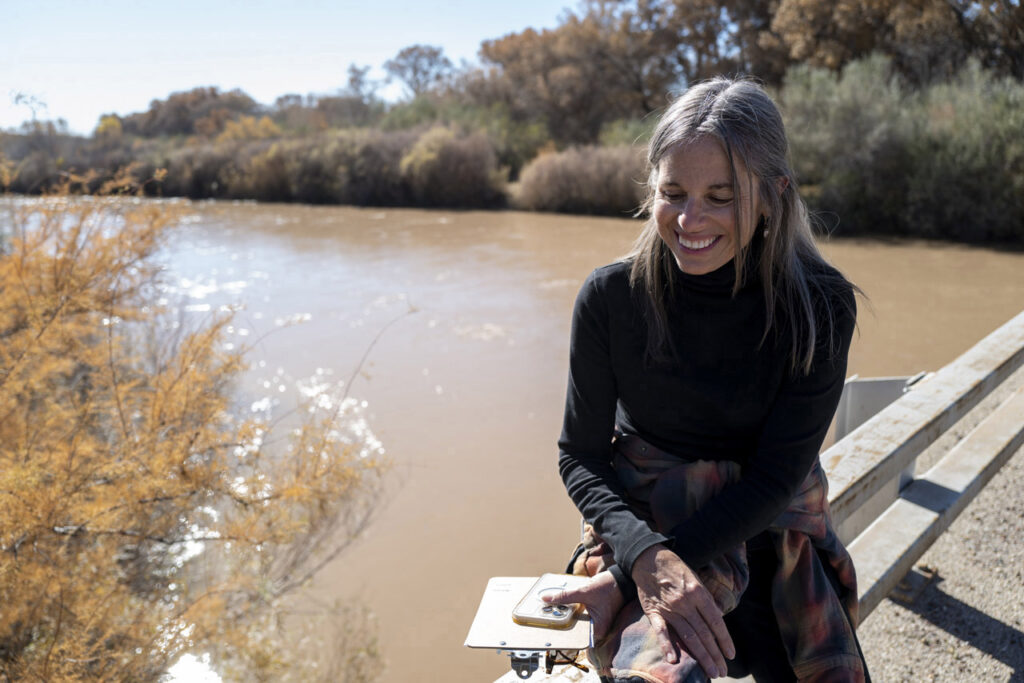
Paula Castillo is a New Mexico-based sculptor whose work explores the relationships between cultural memory, landscape, identity, and civic space. Working across sculpture, installation, and permanent public art, she creates works that engage the histories, environments, and communities of the places they inhabit.
Her public art practice includes three permanent sculptures, Glyph, Equis, and Trestle, on the Denver Art Museum and Denver Public Library campus. Her work has also been exhibited at institutions including the National Museum of Women in the Arts and SITE Santa Fe. Castillo is a recipient of the New Mexico Governor’s Award for Excellence in the Arts and holds an MFA from the University of New Mexico.
Her newest commission, The Lighthouse, is a 32-foot sculptural landmark for Providence’s historic North Burial Ground. Drawing upon the cemetery’s traditional obelisk forms, the sculpture uses graduated color, geometry, and illumination to reconsider the monument as a contemporary civic gesture. Rather than commemorating a single individual, The Lighthouse acknowledges the accumulated histories of the site while offering a welcoming presence within the city. www.paulacastilloart.com